Building More Than Just Skills: How GP Soccer Elite Training Accelerates Player Development

Grady Ponce • March 27, 2026

Share this article

Building More Than Just Skills: How GP Soccer Elite Training Accelerates Player Development


For the ambitious youth athlete, team practice is often not enough. Standard practices focus on team tactics, set pieces, and general fitness. While necessary, this team-centric approach often leaves a gap in individual athletic evolution.


This is where GP Soccer Elite Training provides a definitive advantage. We are not a team; we are a specialized technical academy dedicated to high-level Youth Soccer Development in Camden County, Georgia Click to open side panel for more information .


Our program is engineered to bridge that gap between recreational play and elite technical mastery. When an athlete enters the GP Soccer Elite environment, they are engaging with a unique developmental pathway built on detail-oriented technical precision, structured assessment, and a culture of personal accountability.

Here is a closer look at the key development opportunities when you choose GP Soccer Elite for your athlete.


1. The Opportunity for Unparalleled Technical Mastery

At the center of our curriculum is technical refinement. The primary goal is to turn a player into a Technical Master of the Ball.

While a team practice might afford a player a few dozen touches on the ball during a session, an athlete in our program will receive hundreds—and every single touch is critiqued, corrected, and refined. We focus on:


  • Precision Footwork: Developing the ability to control and manipulate the ball under intense pressure, using every surface of the foot.
  • Mechanics of Movement: We use an "accountant's eye for detail" to break down kicking mechanics, dribbling posture, and receiving shape, identifying the smallest technical flaws that impede elite performance.
  • The First Touch: Engineering a relentless, purposeful first touch that immediately opens attacking angles or breaks defensive pressure.

This intense technical focus doesn't just improve ball control; it builds an athlete’s inherent confidence. When the technical mechanics are automated, the player’s mind is freed to focus on the higher-level aspects of the game.


2. Developing Tactical IQ: Learning to Think "Two Steps Ahead"

Technical skill is useless without tactical awareness. Elite soccer is played in the mind as much as on the field.


We offer the opportunity for athletes to develop their Tactical IQ. Our technical sessions are built with pressure and constraints that force athletes to:


  • Improve Vision & Awareness: Cultivating the habit of scanning the field (checking over the shoulder) before receiving the ball.
  • Speed Up Decision Making: Training athletes to identify spaces, recognize defenders’ cues, and execute the optimal decision in fractions of a second.
  • Understand Spatial Dynamics: Learning when to possess the ball to create an overload and when to play directly into space to break a line.

A GP Soccer Elite athlete doesn't just react to the game; they dictate the game.


3. Mentorship & The "Accounting for Excellence" Philosophy

Our program is fundamentally a system of disciplined growth, leveraging a professional, high-standard culture.


We provide the development opportunity for players to mature outside of the game. When an athlete enters our May to December technical block, they must navigate:


  • Structured Professionalism: Every athlete receives a unique "Technical Audit" (KPI Report), breaking down their development into measurable, data-driven points. Like any elite accountant, we measure what matters, tracking progress through structured KPIs.
  • Performance Accountability: We require athletes and parents to sign our Code of Conduct and Payment & Registration Flyer, establishing that training slots are a privilege and high effort is non-negotiable. This isn't just a "fun hour of practice"—it's an environment demanding focus and respect.
  • Elite Mindset: We focus on resilience, sportsmanship, and the high-intensity discipline required to reach the NPL, ECNL, or collegiate levels that many Camden County players aspire to.


Our standard isn't perfection; it’s disciplined, high-stakes progress.


The "MBA Trainer" Advantage: An Investment in Proven Results

We are not just offering coaching; we are offering a Technical Development Platform.

Because of our high professional standards—which include recurring monthly recurring billing, formal Service Level Agreements (contracts), and robust legal protections for athletes—parents are making a definitive investment in their child’s athletic journey. We ensure that this investment provides a tangible "ROI" (Return on Investment) through visible, measurable athletic development.


Next Steps: Are You Ready for Elite?

The technical gap between recreational play and high-level, elite soccer is massive—and it only widens with age.


If you are a parent of an ambitious soccer player in Camden County, GA (including Kingsland, St. Marys, and Woodbine) and are ready to move beyond the limits of standard team practice, we invite you to experience the GP Soccer Elite difference.


Contact Coach Grady Ponce at grady@gpsoccerelites.com or visit gpsoccerelites.com today to schedule your athlete's professional technical assessment and secure their spot in our next development block.


Recent Posts

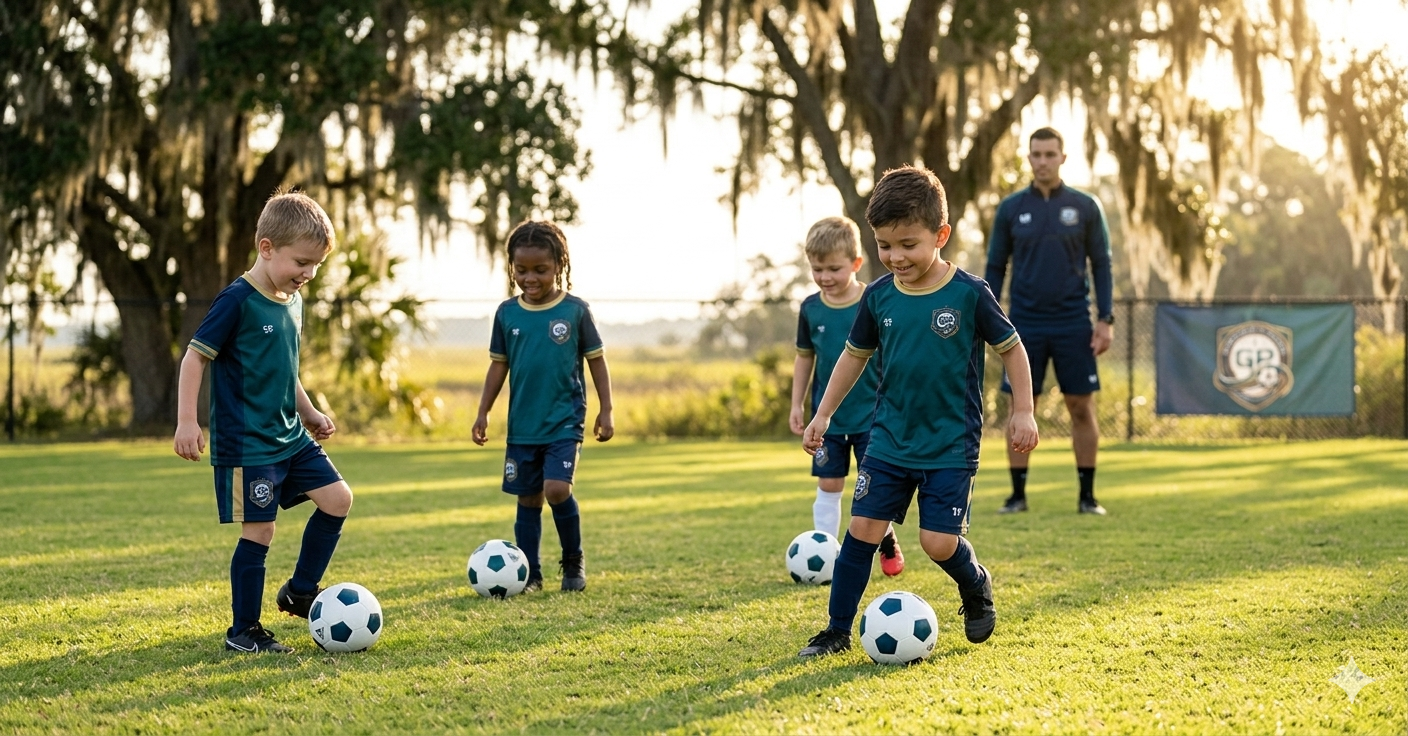
Four children in matching soccer uniforms practicing drills on a sunny field with a coach watching in the background.
By Grady Ponce March 25, 2026
Elevate your athlete’s game with elite technical soccer training in Camden County. We bridge the gap between rec play and ball mastery. Register for elite skills sessions in Kingsland and St. Marys, GA.

A colorful soccer ball sits on the grass in the center of an empty stadium field.
By Grady Ponce March 9, 2026
Navigating the Alphabet Soup: A Parent’s Guide to Boys’ Youth Soccer Leagues Choosing the right soccer environment for your son can feel like navigating a maze of conflicting advice, regional differences, and an exhausting "alphabet soup" of league acronyms. You’ll hear other parents whispering about ECNL, bragging about MLS NEXT, or contentedly discussing their local recreational league. But what do these letters actually mean for your child? This guide is designed to demystify the landscape of American boys' youth soccer, helping you understand where your son fits now, where he might go in the future, and how to make the best decision for his happiness and development. Understanding the "Why" Before the "What" Before diving into specific leagues, it’s crucial to understand that there is no single "best" league . The best league for your son is the one that matches his current skill level, commitment, and goals. A talented player who loves soccer but wants to play other sports or focus heavily on academics may be miserable (and burn out) in a top-tier national league. Conversely, a player who dreams of playing professionally will need the exposure and training found only at the top of the pyramid. The U.S. Boys’ Soccer Pyramid: The Hierarchy Explained To visualize how these leagues relate to one another, think of them as a pyramid. The base is the widest, with the most players and the lowest commitment/cost. As you move up, the number of players decreases, the competition increases, and the demands on your time and wallet grow significantly. Here is a breakdown of the pyramid for boys' youth soccer as it stands today.

A soccer ball with a blue and white star pattern sits on a vibrant green grass field, with blurred figures in the background.
By Grady Ponce March 9, 2026
The Roadmap to Success: A Parent’s Guide to Girls’ Youth Soccer Leagues

Aerial view of a rectangular green soccer field with white boundary lines and players scattered across the pitch.
By Grady Ponce March 9, 2026
The "Filter" Statistics: How Many Make It? According to data from the NCAA and major youth organizations, the chances of playing at the next level are highly dependent on the league "platform." General Probability High School to NCAA (Overall): Only 5.7% of high school boys and 7.2% of high school girls go on to play for an NCAA institution (DI, DII, or DIII). The "Elite" Advantage: If a player is on an ECNL or MLS NEXT/GA roster, that probability jumps significantly. For example, over 90% of ECNL Girls players traditionally go on to play some level of college soccer. College Commitment by League (Estimated) The following table shows the "recruitment weight" of each league. This represents where college coaches spend their limited travel budgets to scout.