

The Roadmap to Success: A Parent’s Guide to Girls’ Youth Soccer Leagues

Grady Ponce • March 9, 2026

Share this article

The Roadmap to Success: A Parent’s Guide to Girls’ Youth Soccer Leagues

Navigating the world of girls' youth soccer can feel like a full-time job. With various leagues claiming to be "the best" and an ever-evolving landscape of recruitment pathways, it’s easy for parents to feel overwhelmed. On the girls' side, the structure is slightly different from the boys', with a very clear "Big Two" dominating the elite landscape.

This guide breaks down the hierarchy of girls' soccer to help you find the right competitive fit for your daughter’s talent, ambition, and lifestyle.


The Reality of the Girls' Pathway

Unlike the boys' side, which is heavily influenced by professional MLS academies, the girls' elite pathway in the U.S. is primarily driven by college recruitment. The top tiers are designed specifically to put players in front of NCAA Division I, II, and III scouts.


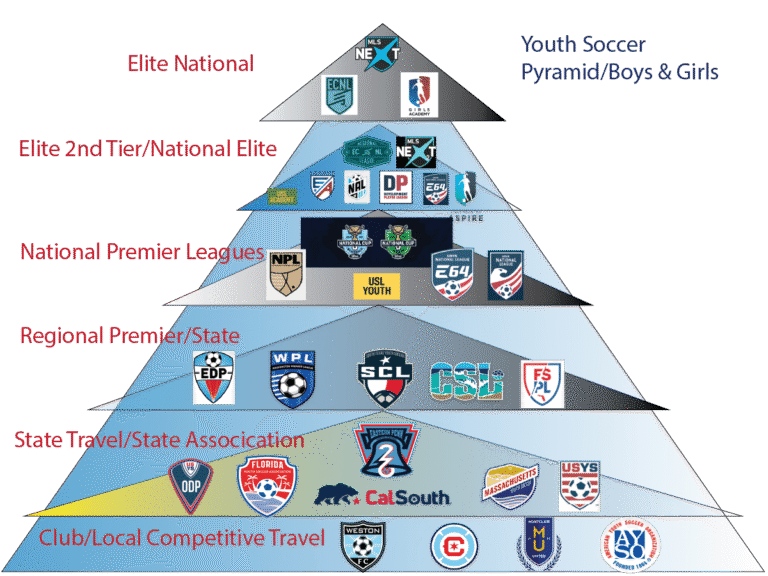
The U.S. Girls’ Soccer Pyramid: The Hierarchy Explained

To understand where your daughter stands, visualize the soccer landscape as a pyramid. While the "Top" represents the highest level of play, it also represents the highest level of travel and financial commitment.


This is paragraph text. Click it or hit the Manage Text button to change the font, color, size, format, and more. To set up site-wide paragraph and title styles, go to Site Theme.

Detailed Breakdown: The "Big Two" Elite Leagues

In girls' youth soccer, the conversation at the elite level almost always centers on ECNL and the Girls Academy (GA).


1. ECNL Girls (Elite Clubs National League)

  • What it is: Widely considered the "Gold Standard" for girls' youth soccer in the U.S. It consists of the top-performing clubs in the country.
  • The Focus: Maximum exposure to college coaches. ECNL National Showcases are the most heavily scouted events in the world for female youth players.
  • Parental Considerations: Highest level of commitment. Practices are usually 3–4 days a week. Travel is extensive, involving multiple out-of-state flights per year for league games and national showcases.
  • Key Fact: A huge majority of Power 5 (ACC, SEC, Big 10, etc.) college commits come from ECNL rosters.


2. Girls Academy (GA)

  • What it is: Formed by former members of the now-defunct U.S. Soccer Development Academy. It is the primary rival to ECNL.
  • The Focus: The GA emphasizes "player voice" and a holistic approach to development while maintaining an incredibly high level of play. It also provides a direct pathway to college and youth national teams.
  • Parental Considerations: Similar to ECNL in cost and travel. The GA allows for more flexibility regarding high school soccer participation (which ECNL also generally allows, though some clubs vary).
  • Key Fact: The GA is known for its "Talent ID" events which help identify players for U.S. Soccer National Team cycles.


The Second Tier: DPL and USYS National League

If your daughter is a high-level player but isn't quite at an ECNL/GA club (or wants slightly less travel), these leagues are excellent alternatives.


  • DPL (Development Player League):
  • Often serves as the "reserve" or second-tier league for GA clubs. It offers a national showcase platform and high-level regional play without the extreme intensity of the top tier.
  • USYS National League (P.R.O.):
  • A performance-based league where teams must earn their way in through winning state and regional conferences. It is highly respected and offers a clear path to the USYS National Championships.


Choosing the Right Path: 3 Questions for Parents

When deciding which level is right for your daughter, look past the "prestige" of the league name and ask these three practical questions:

  1. Does she want to play in college? If the answer is a definitive "Yes" to Division I, aiming for ECNL or GA is the most direct route. If she wants a balanced college experience (DIII) or doesn't want to play in college, a Regional Premier league (like EDP) offers great soccer without the $8,000+ annual price tag.
  2. Can our family handle the travel? Elite girls' soccer is a "travel-heavy" sport. Many weekends will be spent in hotels or on planes. Ensure this fits your family's budget and schedule before committing.
  3. Is she the "big fish" or the "small fish"? Sometimes it is better for a girl's confidence and development to be a starter and leader in a Regional Premier league than to be a bench player on an ECNL team. Development happens on the field, not on the sidelines.

Recent Posts

By Grady Ponce March 9, 2026
Navigating the Alphabet Soup: A Parent’s Guide to Boys’ Youth Soccer Leagues Choosing the right soccer environment for your son can feel like navigating a maze of conflicting advice, regional differences, and an exhausting "alphabet soup" of league acronyms. You’ll hear other parents whispering about ECNL, bragging about MLS NEXT, or contentedly discussing their local recreational league. But what do these letters actually mean for your child? This guide is designed to demystify the landscape of American boys' youth soccer, helping you understand where your son fits now, where he might go in the future, and how to make the best decision for his happiness and development. Understanding the "Why" Before the "What" Before diving into specific leagues, it’s crucial to understand that there is no single "best" league . The best league for your son is the one that matches his current skill level, commitment, and goals. A talented player who loves soccer but wants to play other sports or focus heavily on academics may be miserable (and burn out) in a top-tier national league. Conversely, a player who dreams of playing professionally will need the exposure and training found only at the top of the pyramid. The U.S. Boys’ Soccer Pyramid: The Hierarchy Explained To visualize how these leagues relate to one another, think of them as a pyramid. The base is the widest, with the most players and the lowest commitment/cost. As you move up, the number of players decreases, the competition increases, and the demands on your time and wallet grow significantly. Here is a breakdown of the pyramid for boys' youth soccer as it stands today.

By Grady Ponce March 9, 2026
The "Filter" Statistics: How Many Make It? According to data from the NCAA and major youth organizations, the chances of playing at the next level are highly dependent on the league "platform." General Probability High School to NCAA (Overall): Only 5.7% of high school boys and 7.2% of high school girls go on to play for an NCAA institution (DI, DII, or DIII). The "Elite" Advantage: If a player is on an ECNL or MLS NEXT/GA roster, that probability jumps significantly. For example, over 90% of ECNL Girls players traditionally go on to play some level of college soccer. College Commitment by League (Estimated) The following table shows the "recruitment weight" of each league. This represents where college coaches spend their limited travel budgets to scout.